

A flush draw is a hand with four cards of the same suit that still needs a fifth card of that suit to become a flush. To count the cards that complete it, start with the suit’s 13 cards and subtract the four you can already see, combining your hand and the board: nine unseen cards remain, which is why a standard flush draw is called a nine-out draw. Here, an out is simply a card that completes the combination you are aiming for [2][3][4].
Counting answers a practical question: how many cards can still give me a flush? On the flop, a nine-out flush draw has about a 19% chance of completing on the turn. With both cards to come, the same flush draw has about a 35% chance of completing on the turn or river [2]. These figures are approximations for the standard nine-out case in Texas Hold’em and measure only the chance of completing the draw. They do not tell you whether the flush, once made, wins the pot: that depends on how high your flush is, the board, and your opponents’ hands, as the paired-board example below shows [3][4].
Flush Draws in Poker: How to Recognize Them and Count the Cards That Complete Them
To recognize a flush draw in Texas Hold’em, look for four cards of the same suit among your two hole cards and the community cards. The most common scenario is having two cards of the suit in your hand and two on the board, leaving you one card away from making a five-card flush on the turn or river [4]. A flush means five cards of the same suit, while a draw means you do not yet have a made hand, only the possibility of making it if another card of the required suit comes [1]. Until that card appears, you have a draw, not a flush.
With only three cards of the suit on the flop, the draw is a backdoor and needs that suit on both the turn and river [3][4]. In Omaha, you must use exactly two hole cards; this article counts cards for Texas Hold’em [4].
First Example: Nine Candidates on the Flop
Hypothetical example 1: in Texas Hold’em, you hold A♠ 6♠ and the flop is 9♠ 4♠ K♦, with the turn still to come and your opponent’s hand unknown. Between your hand and the board, there are four spades (A♠, 6♠, 9♠, and 4♠), so you have a flush draw. Since the suit has 13 cards, 13 - 4 = 9 unseen candidates to complete the flush on the turn: K♠, Q♠, J♠, 10♠, 8♠, 7♠, 5♠, 3♠, and 2♠. The other cards do not complete the flush on this next card; A♥ and K♣, for example, are not spades, and K♦ is already on the board.
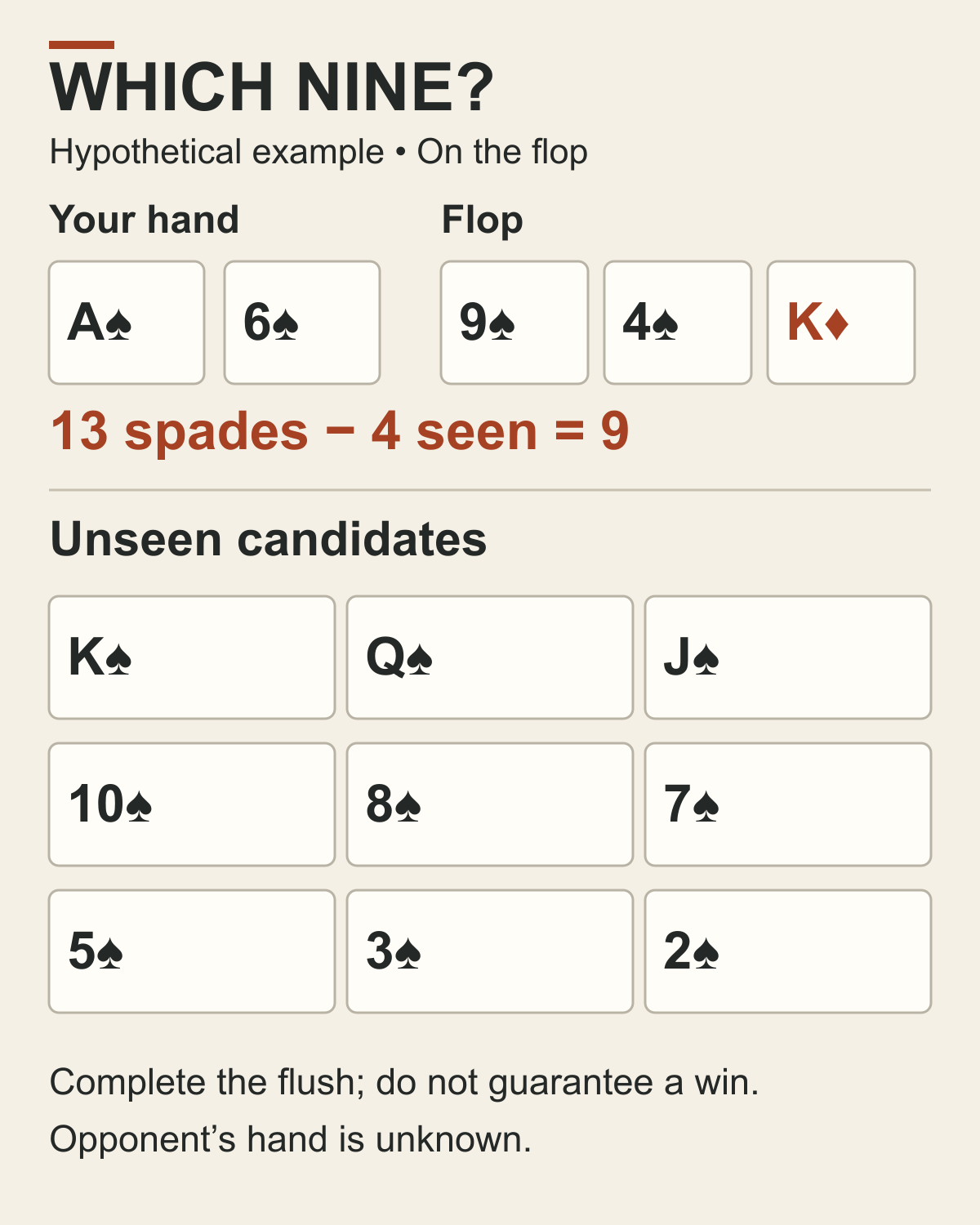
The list shows which turn cards complete the flush and which do not: only spades count, because the target of the count is the flush. These are nine unseen candidates, not nine cards guaranteed to be in the deck: without knowing your opponent’s hand, you cannot know whether they hold any of them [4]. Since your draw uses the ace of the suit, this is a nut flush draw: if a spade comes, no other flush can be higher than yours [2][3]. If the turn does not help, the same list applies to the river, now with only one card to come.
Counting the cards that complete the draw takes four steps:
- Confirm the four cards of the suit, combining your hand and the board. Count the cards you can use in Texas Hold’em.
- Subtract from the full suit. Each suit has 13 cards; if you can see four, nine remain that complete the flush [3][4].
- Remove what has already been revealed. Cards of that suit that you know are out of the deck are no longer candidates. If an opponent holds cards of your suit, the actual number of outs decreases; when the opponent’s hand is unknown, the standard count does not subtract unrevealed cards [4].
- Determine how many cards are still to come. On the flop, two remain (turn and river); on the turn, one remains (river).
This is the logic behind any out count: list the cards that have not yet appeared and that make the combination you are aiming for.
One card to come and two cards to come are different questions. The higher figure in the introduction applies to the turn and river combined; the lower figure applies to a single card. Mixing them up is a common mistake [1]: many players, including beginners and even some more experienced players, confuse the chance of making a flush by the river with the chance of making it on the next card alone, and end up making mathematically poor decisions. For a mental estimate, multiply the outs by 2 (the next card) or by 4 (the next two cards). With nine outs, the result is close to the figures above, but it is only an approximation [1][3], and exact figures vary depending on the cards already dealt and other factors [4]. Readers who want to compare other draws can find the chance of completing a draw in a separate article.
The assessment changes with each card revealed. If the turn does not complete the flush, the same nine candidates remain, with only one card to come: in simplified terms, the flush draw has approximately a 19% chance of hitting on the river [4]. Compared with the chance across two cards from the flop, this figure covers only the river; it does not mean a candidate card has disappeared.
The flush may not be the highest. A nut flush draw is a draw to the best possible flush, which uses the ace of the suit. If the ace is on the board, the player needs the king of the suit; if the ace and king are on the board, the queen, and so on [2]. When the draw is not to the nuts, the completed flush can lose to a higher flush, but that depends on which cards come and who holds them. Poker Skill illustrates this with K♥ 9♥ on a Q♥ 7♥ 2♣ flop: eight of the nine remaining hearts give you a king-high flush, and the draw is described as non-nut because someone holding A♥ with another heart makes an ace-high flush [3]. A non-nut flush is not automatically a great hand, and even when you hit your card, you may have the second-best hand, a risk described by the concept of reverse implied odds [3].
Continuing the Example: Completing the Flush Without Winning the Hand
Hypothetical example 2: continuing the previous Texas Hold’em situation, the turn is 7♠, one of the nine candidates, and the river is K♣, which pairs the board. The complete board is 9♠ 4♠ K♦ 7♠ K♣. You hold A♠ 6♠, and your opponent holds K♥ 9♥. Your best five-card hand is a spade flush, with A♠ 9♠ 7♠ 6♠ 4♠. Your opponent’s best hand is a full house, with K♥ K♦ K♣ 9♠ 9♥, and they win because a full house beats a flush.
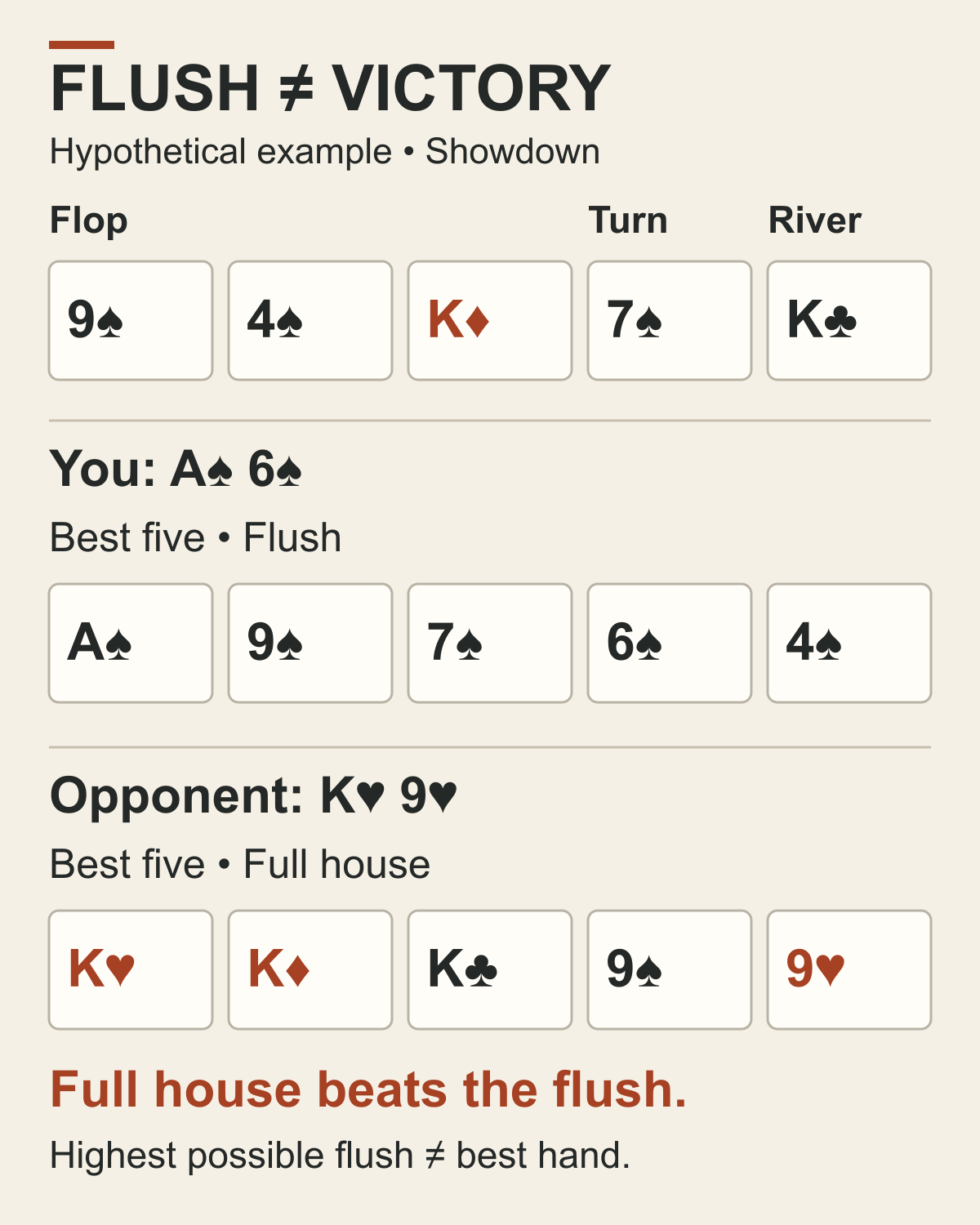
You completed the flush on the turn, making the highest possible flush, and lost at showdown. The count of nine was not wrong: it measured the chance of a spade appearing, and 7♠ appeared. What it did not measure was how the board could still develop: when the river paired the king, your opponent’s best hand became a full house. A paired board is precisely the situation in which a full house can beat a flush [4].
The lesson for reading the next card is to make two assessments in sequence: how many cards complete the flush, and whether the completed flush would be the best hand on that board, including after the board pairs. A single case does not measure how often an opponent has a full house; it shows why counting outs alone does not answer the question of your chance of winning.
Next Step: Read the Next Card with Two Questions
In the next hand you play or review, use the examples as a practical check:
- Without looking at the first example’s list, identify the four known spades. Then check which nine remain. This tests whether you counted each card only once.
- Decide which question you are asking: hitting on the next turn, or reaching the river with a flush? Choose the time horizon before looking at the percentage; do not use the two-card figure for the next card alone.
- In the continuation with the K♣ river, put the two best five-card hands side by side. Check why hitting the spade on the turn did not prevent the full house from winning.
The count alone also does not indicate whether calling a bet is worthwhile, because that depends on the price, position, and stack depth, as well as whether the draw is to the nut flush or a weaker one [3].
Recommended reading
- What Are Outs in Poker: Counting Cards Without Double Counting or Ignoring Dirty Outs
- Reverse Implied Odds in Poker: When Improving Costs More
- Backdoor draws in poker: why two cards are needed
Sources
- [1] 3 Strategies for Playing a Flush Draw on the Flop and Turn — pokernachapa.com.br (published January 6, 2020)
- [2] Flush Draw - Glossary of Poker Terms — PokerStrategy.com (published July 15, 2026)
- [3] Flush Draw in Poker: 9 Outs, Odds, How to Play It — Poker Skill
- [4] Flush Draw — PokerNews

 1 day ago